
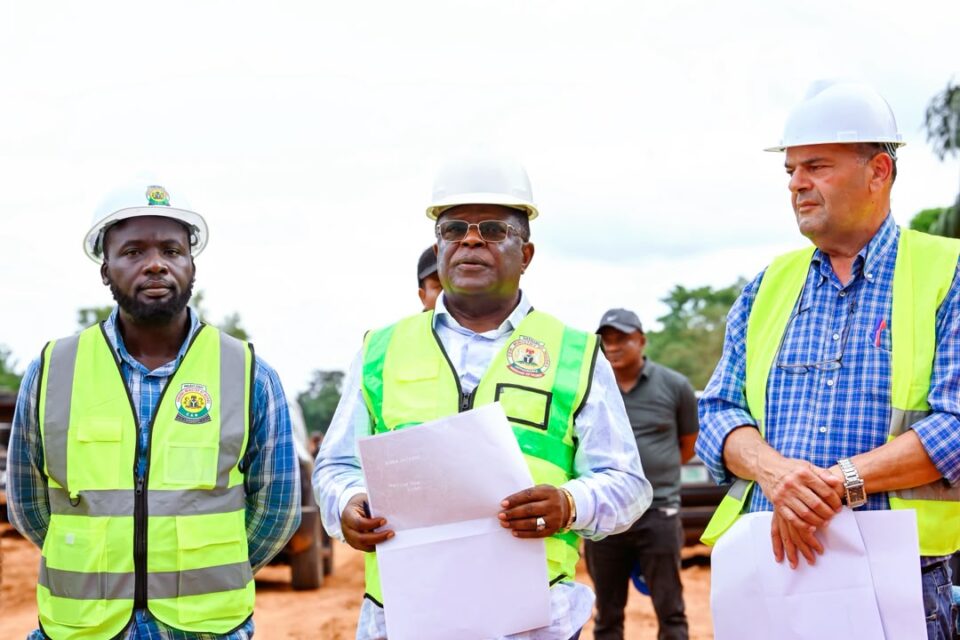
The Minister of Works, Senator Engr. David Umahi, has directed contractors handling the Calabar-Abuja Superhighway to ensure that no building is demolished or touched along the project alignment until the Federal Government concludes a review and, where necessary, realigns the route.
Umahi gave the directive on Friday, September 23, 2026, during an inspection of Phase Two of the Calabar-Abuja Superhighway at Ado in Benue State, where he also reviewed progress on the project and directed contractors to accelerate construction activities.
The minister said the second section of the project covers 173 kilometres and is valued at ₦683 billion, while Section One is valued at ₦454 billion. He
The contractor on Section Two, according to Umahi, has already opened the first element of the first eight kilometres, while efforts are being intensified to resolve the engineering challenge around the Ado Bridge.
“I do not believe in engineering that anything is impossible,” Umahi said, explaining that he had directed the contractor to open another section from the Ado River while the engineering team works out the best solution for crossing the bridge.
He also directed that at least three sections of the first element of Section Two should be opened simultaneously to increase the pace of work, adding that he would personally engage the project manager on site to agree on the technical and practical steps required.
Umahi commended the contractor for the progress recorded since his last inspection, saying, “From the last time we were here until now, he has done very well, and I’m very proud of what he’s doing.”
The minister, however, gave a clear instruction concerning buildings located within the current alignment, stressing that the human impact of the project must be carefully considered.
“My directive is that no building should be touched. Even if it’s within the alignment, I have to come and realign it. So you just have to continue your work and go around those buildings until we come to look at it,” he said.
He further directed that sharp curves along the highway should be strengthened, irrespective of what may have been contained in the original design, stressing that experienced professionals were needed on major infrastructure projects because engineering realities on the ground sometimes require adjustments.
Umahi explained that the project was being executed under an EPC Plus Finance arrangement, under which variations are not provided for, making it necessary for the project team to carefully manage quantities and resources without imposing additional costs on the Federal Government.
The minister also highlighted additional works being undertaken under Section One, including the dualisation of the road at Onueke, which he said was outside the initial scope, as well as the dualisation at Chainage 0 around Ndibe Beach.