
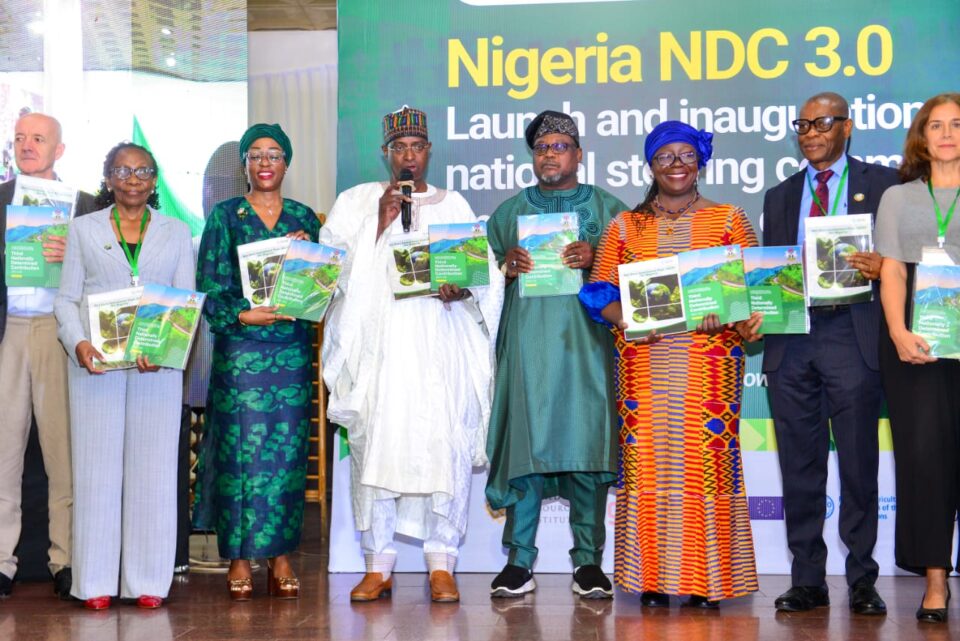
The Federal Ministry of Livestock Development has pledged to strengthen climate-smart livestock production, improve resilience across livestock value chains and reduce greenhouse gas emissions as Nigeria advances implementation of its Third Nationally Determined Contribution (NDC 3.0).
The Honourable Minister of Livestock Development, Idi Mukhtar Maiha, stated this on Thursday 22nd October 2026, at the launch of Nigeria’s NDC 3.0 and the inauguration of the National Steering Committee for the implementation of the NDC and Net-Zero Investment Plan.
Maiha described livestock as central to Nigeria’s food security, employment, poverty reduction and economic growth, noting that climate change poses growing risks to animal health, productivity, pastoral livelihoods and the stability of livestock value chains.
“Rising temperatures, droughts, floods, water scarcity, pasture degradation and shifting disease patterns threaten animal health, productivity, pastoral livelihoods and livestock value chain stability,” he said, calling for coordinated, evidence-based interventions.
The Minister explained that the Ministry was promoting climate-smart, low-emission livestock production through a Climate-Smart Implementation Plan under the National Livestock Growth Acceleration Strategy. The approach includes improving animal nutrition, feed conversion efficiency, livestock genetics, animal health services, herd management and manure management to reduce emissions while increasing productivity and profitability.
He also highlighted efforts to strengthen adaptation through sustainable water supply, fodder development and climate-resilient feed systems in selected grazing reserves and Livestock Development Centres, alongside disease surveillance, improved health infrastructure and early-warning systems.
As part of efforts to improve climate data and evidence-based decision-making, Maiha disclosed that the Ministry was advancing a livestock measurement, reporting, verification and certification system and undertaking a methane baseline survey. He added that five digital weather stations had been installed to provide information on atmospheric pressure, wind speed, humidity and soil conditions.
“The success of the implementation of NDC 3.0 depends on effective mobilisation of investment, technology and partnerships, as government resources alone are insufficient to facilitate the required transformation,” the Minister said.
In the same vein, the Secretary to the Government of the Federation, Senator George Akume, represented by Professor Babatunde Bolaji Bernard, said NDC 3.0 should be treated as a national development instrument, with climate priorities integrated into government policies, budgets, infrastructure and investment decisions.
The Director-General of the National Council on Climate Change, Mrs Omotenioye Majekodunmi, said the focus must now shift from announcing commitments to implementation, investment and measurable results.
“Our task today is not simply to launch another document. It is to move from ambition to delivery, from pledges to governance,” Majekodunmi said, emphasising the need to translate national commitments into investable actions, stronger partnerships and measurable outcomes.
She noted that Nigeria’s NDC 3.0 sets an economy-wide ambition to reduce emissions by 32 per cent by 2035, relative to the 2018 base year, on the pathway towards net-zero emissions by 2060. She also called for credible project pipelines, transparent implementation programmes and policy certainty to attract public and private investment.
Development partners at the event highlighted the importance of international cooperation, technical assistance, climate financing and institutional capacity-building in translating Nigeria’s climate commitments into practical results.
In her contribution, the United Nations Development Programme (UNDP) Resident Representative in Nigeria, Ms Elsie Gyekyewaa Attafuah, emphasised the need to connect national climate policies with tangible improvements in the lives and livelihoods of Nigerians.
“For many Nigerians, climate change is experienced through everyday concerns – whether the rains will sustain the harvest, whether flooded roads will prevent children from reaching school, or whether extreme heat will affect their health and ability to work,” Attafuah said.
She noted that climate action could strengthen food security, protect livelihoods, improve public health and enhance business competitiveness, citing climate-resilient agriculture, reliable clean energy and cleaner cooking as examples of interventions with direct benefits for communities and enterprises.